

INTEGRITY IN THE SUPERVISORY DIRECTOR’S CORE DUTIES
Every Supervisory Board has three core duties.
CORE DUTIES OF THE SUPERVISORY BOARD
Every Supervisory Board has three core duties:
- Supervising the implementation of the strategy and safeguarding the continuity of the organisation;
- Acting as an adviser to the Management Board;
- Acting as the employer of the Management Board.
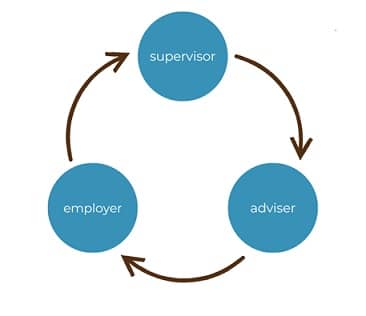
This chapter explains how each of these roles can be fulfilled in relation to integrity. This is only an initial exploration. The following chapters provide more practical tools to help you fulfil the various roles.
SUPERVISING THE STRATEGY’S IMPLEMENTATION
One of the core duties of supervisory directors is to supervise the implementation of the adopted strategy and the achievement of strategic objectives with a view to the organisation’s long-term value creation and continuity.
An integrity violation can pose a threat to the achievement of strategic objectives and, in serious cases, may even jeopardise the organisation’s continued existence. It is therefore important for the organisation to have insight into the main integrity risks and to develop policies to mitigate those risks to an acceptable level.
As a supervisory director, it is advisable to be involved in the integrity risk analysis. You can use your broad knowledge and experience to gain insight into the integrity risks that could jeopardise the achievement of strategic objectives or threaten the organisation’s continued existence.
ACTING AS AN ADVISER TO THE MANAGEMENT BOARD
Supervisory directors should be available as advisers and critical sounding boards for the Management Board. They may provide this advice either upon request or on their own initiative. Matters of integrity and actual or suspected misconduct are often sensitive. The Management Board cannot always discuss such matters internally, particularly if a situation involves one of the other management board members. It is important that management board members can consult supervisory directors, for example to discuss societal developments and trends, possible integrity concerns and the resolution of dilemmas.
ACTING AS THE EMPLOYER OF THE MANAGEMENT BOARD
The Supervisory Board acts as the employer of the members of the Management Board. This means that the Supervisory Board should engage in dialogue with management board members about their leadership role and the role-model behaviour. Ideally, these discussions should place when there are no issues, to ensure an open discussion, free from judgement and tension. These conversations are foundational for the expected behaviour of management board members. If concerns about a management board member’s conduct were to arise at some point, this discussion is based in a shared understanding of expectations.
Should any reports be made on a management board member, it is up to the Supervisory Board to determine what action should be taken. Employees or other stakeholders may contact a supervisory director directly to report a suspected integrity violation. Such reports may also concern a management board member. The supervisory director must know what to do in order to adequately follow up on the signal. An investigation may be necessary, but it is not always the best option. Sometimes a conversation or mediation leads to better results. If it is decided an investigation should be conducted, the Supervisory Board will often commission that investigation. The next chapter provides practical tools supervisory directors can use to fulfil their duties as the Management Board’s employer in relation to integrity.
DUTIES, RESPONSIBILITIES AND POWERS SHOULD BE ANCHORED IN REGULATIONS
The duties, responsibilities and powers of the Supervisory Board in relation to the organisation’s integrity policy, the integrity of management board members and the follow-up to any reports should be laid down in the Supervisory Board regulations, the Management Board and Executive Committee regulations and/or the reporting procedure.